 Modal data sheet.
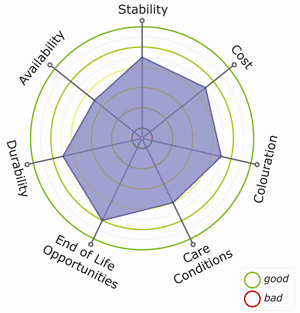
Property summary for Modal
End of life Opportunity summary for Modal
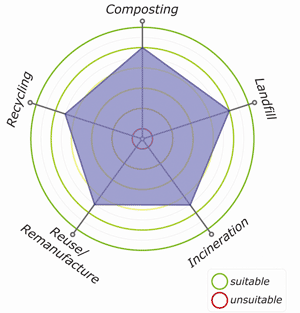
Characteristics / options defined by the above graphs are proportionally represented and approximate,
and are only intended as a guide. As such they do not represent any industry standards. Among other
things, fabric construction and weight will influence the perceived ranking.
Data Sheet for Modal
| General | Regenerated Cellulose fibre. Modal fibres are a form of viscose fibres and manufactured through a complex chemical process. Converted into a series of intermediate cellulose compounds, the final spinning process regenerates cellulose from a cellulose xanthate dope. Involving strong sodium hydroxide and sulphuric acids as well as carbon disulphide, there are environmentally concerns surrounding the process. Modal fibres have improved wet strength over standard viscose fibres and is abrasion resistant yet soft to handle and has good drape properties. It is extremely adsorbent and breathable which combine to make garments made from the fibre comfortable. |
|---|---|
| Available as: | Knitted and woven in 100% and blended. Modal is supplied as 100% or more frequently in blends. In this latter application it is used to improve the underlying properties of the other fibres. Modal yarns can be knitted or woven and come in a range of yarn/fabric weights. |
| Colouration | Treat to remove sulphur and use cellulose dyes. Modal fibres will have similar requirements to viscose as they will contain a significant concentration of residual sulphur based chemicals from their processing. It is therefore essential that a suitable bleaching/scouring is carried out prior to any dyeing process. Dyeing modal fibres is totally compatible with cotton systems and as such can be carried out with reactive dyes or in some cases direct dyes. It is also possible to get pigment dyed fibres that have been spun from coloured dope. If garments must be suitable for the heavier duty applications in work wear then reactive dyes, vat dyes or sulphur dyes would be recommended. |
| Dimensional Stability |
Excellent dimensional stability. |
| Resistance to pilling |
Resistant to pilling. The abrasion resistance and pilling resistance of Modal is good |
| Moisture regain |
Better than cotton 12-15%. Modal has a high level of moisture regain, typically 12-15% at 65% RH 20°C |
| Care information |
Cool wash. Easy care, suitable for cool washing. |
| Applications | Knitwear, leisurewear. ladies’ knitwear, leisurewear |
| End of life Possibilities |
Can be disposed of using all end of life opportunities. Modal is a variant of viscose fibre, being produced using the same process but under modified conditions. It can be treated as viscose fibre. It is 100% cellulose and as such it is biodegradable. The fibre has also the potential for re-use and remanufacture. Where used as 100% there is the possibility of using the fabrics as a raw material for regenerated cellulose fibre production. When present in blends, the end of life options are reduced. However if blended with other cellulose fibres then the blend can be treated as cellulose feed stock for a regenerated cellulose process. The re-use of the non-woven viscose fabrics will depend on the way they have been manufactured. |
| Eco aspects | |
| Cost scope (economic impact) |
|
| Common trade names |
Lenzing Modal |
| Alternatives | |
| Specialists | Lenzing Fibers Limited 1 Pride Point Drive Pride Park Derby Derbyshire UK DE24 8BX Phone: +44 (0)1332 546 740 Fax: +44 (0)1332 546 741 |
| © | Oakdene Hollins Ltd., 2009 for the CRR Uniform Reuse Project www.uniformreuse.co.uk |